

Progress in medicine is rarely loud.
At LAU Medical Center - Rizk Hospital, it didn’t arrive as a single breakthrough, it accumulated quietly, one first at a time, across decades of conviction, risk-taking, and belief that healthcare in Lebanon could always go further.
This is not just a history of medicine; it is a timeline of firsts that changed what “possible” looks like.
It started with access to survival
In 1971, one of Lebanon’s first hemodialysis centers opened its doors, bringing life-sustaining treatment for kidney failure at a time when it barely existed in the country.
Two years later, in 1973, the Dr. Toufic Rizk Foundation established a nonprofit blood bank. It would later become the Centre Libanais de Transfusion Sanguine, a cornerstone in national emergency care.
Even during war, progress didn’t stop
In 1981, amid the Lebanese Civil War, Dr. Assaad Rizk began construction on Building B.
It wasn’t just infrastructure; it was a statement: healthcare would continue, regardless of uncertainty.
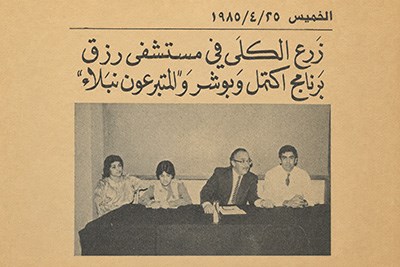
By 1985, that belief became a breakthrough, Lebanon’s first kidney transplant program, giving patients a second chance at life.
A shift toward modern cardiology and minimally invasive care
The 1990s marked a turning point.
- 1993: First percutaneous mitral dilatation in Lebanon
- 1994: First coronary stent procedure
These weren’t just procedures, they redefined how heart disease could be treated, moving toward safer, less invasive solutions.
By 1998, innovation expanded further:
- First carotid angioplasty and stent procedure
- First Transjugular Intrahepatic Portosystemic Shunt (TIPS) procedure for portal hypertension
In 1999, two more national firsts followed:
- One of Lebanon’s first cardiac transplantations
- First percutaneous closure of inter-atrial communication
Building systems, not just procedures
In 2002, two milestones came from two very different dimensions of care:
- Lebanon’s first rooftop helipad, faster emergency response when every second matters
- First ISO 9001-certified medical center in the country, formalizing quality as a system, not a promise
From there, surgical innovation accelerated:
- 2003: First endoscopic spine surgery in Lebanon through a minimally invasive approach
- 2005: First total vertebral replacement via a thoracic approach
- 2006: First minimally invasive hip replacement
Cardiac innovation reaches new thresholds
- 2012: First transcatheter aortic valve implantation (TAVI) in Lebanon.
- 2015: First MitraClip procedure in Lebanon.
These expanded treatment options for high-risk patients who previously had none.
A shift toward coordinated critical care
In 2018, Lebanon’s first Comprehensive Stroke Center was launched, a specialized facility that delivers rapid, multidisciplinary stroke care and significantly improves patient survival and recovery rates. It transformed stroke care into a coordinated, time-critical system rather than isolated intervention.
Enter precision medicine and hybrid technology
2022 marked a new era:
- First hybrid operating room in Lebanon
- First retinal image of a baby using Optos Ultra Widefield system
- First transcatheter mitral valve implantation in Lebanon
Care became more integrated, more precise, and more technologically driven.
Pushing electrophysiology forward
- 2024: First pulsed-field ablation procedure for atrial fibrillation in Lebanon
A safer, more targeted approach to treating complex arrhythmias using FDA-approved technology.
In 2026: precision becomes next-generation
The cardiac arrhythmia team performed a next-generation pulsed-field ablation guided by 3D mapping.
Not just a procedure, a refinement of precision itself.
More than milestones
Across more than five decades, these “firsts” are not isolated achievements.
They are a pattern.
A continuous refusal to treat limits as permanent.
And a long-standing commitment to one idea:
Patients in Lebanon deserve access to the future of medicine, not later, but now.